So, Maine has gone ahead and repealed its same-sex marriage law. Perhaps this is the time to stop and think about this, ask ourselves why people are so vehemently opposed to same-sex marriage in the first place. I think there’s an easy answer – religion. But maybe my meaning isn’t what you think.
I propose that most people, and especially those opposed to same-sex marriage, think of marriage as an essentially religious event. And they see the support of same-sex marriage as getting the government involved in their religion. They forsee government telling them who they have to allow to marry in their church, and it makes them crazy. And you know what? They’re right.
Marriage is a religious event masquerading as a civil event, or rather as a series of civil events. It’s a financial and legal joining of two households, a simple substitute for a will, medical power of attorney, financial power of attorney, a joint custody agreement (in case of children) and so on. I’m sure there’s a list somewhere online that details all of the things marriage represents in law. My point is: it shouldn’t.
Perhaps marriage should be left up to the churches. They could decide who can get married, how they can get married and whether the marriage is under any circumstances allowed to end before the end of time. But (and here’s the important part) it wouldn’t (and shouldn’t) have any force or meaning in civil law. Just as baptism/christening doesn’t (and shouldn’t) determine what your legal name is. Domestic partnerships would take up the legal end of things.
What is the possible objection? It provides freedom of religion without making anyone a second class citizen. Government still gets to push around the same people it was pushing around before, only religion doesn’t tie it’s hands. Religions get to set clear rules… or byzantine structures that can only be interpreted by the chosen initiates – as they wish. And we, the people, can get on with our lives, and stop butting into everyone elses. Pretty much the only people who will see this as a loss are those who think Christian Morality (read as /their/ morality) ought to have force of law for all people. And quite frankly, I’ve had about enough of their bullshit.
There’d be a lot of legal issues to get straight before it could be put in place of course. For instance, what if you get married in church, but do not put a domestic partnership in place to support it? How will existing marriages be handled? What if you have an existing state marriage, but object to the domestic partnership on philosophical or religious grounds? Do you have to accept it? I’ll leave all of that to the lawyers.
And for the future, I forsee arguments about multiple domestic partnerships, group domestic partnerships, and customized domestic partnerships (with prohibitions on certain behaviors (sex ouside of partnership, smoking, drug use)? financial restrictions? expiration dates? Lotsa fun. The lawyers should love it, too! See, everybody wins.
Showing posts with label religion. Show all posts
Showing posts with label religion. Show all posts
11/04/2009


3/17/2008
Easter Approacheth...
and with it, comes the perennial discussion about the determination of the date on which Easter will fall each year. Now, I'm a pragmatist from way back. So when, as a youngster, I got to  wondering about the determination of Easter, I pulled out that year's calendar, and one from the previous year, and attempted to figure it out. I'd heard that it had something to do with the full moon, and with the start of spring, but no matter how I tried, I couldn't make the dates on those calendars obey a fixed rule.
 Fast forward a dozen or so years, and I'm dealing with the comparison between the Western and Eastern (or Orthodox) church calendars. For most holidays (Christmas and New Year's, for example), you simply add 13 days to the Western date to get the Eastern date. This, I knew, was due to the different versions of the calendar the assorted churches used. Western churches used the Gregorian calendar, Eastern churches, the Julian calendar. No biggie. After all, if you use the appropriate calendar, Christmas falls on December 25th. The argument is over when December 25th is.
But Easter isn't so simple. At first it seems like it should be. After all, if Easter is determined based on Full Moons and the start of spring, it shouldn't matter which calendar you use. Spring is spring and a moon is full whether the calendar you use if Gregorian, Julian, Hebrew, Coptic, Mayan or Fischer Universalist, right?
 Well, this is where we hit trouble. For it seems that the Western church stopped paying attention to the sky when figuring spring and full moons about 1500 years ago. Instead, of using the actual full moon and actual equinox, they used the ecclesiastical full moon and ecclesiastical equinox(March 21st) when calculating the date of Easter. The Eastern Orthodox churches, however, base the date of Easter on the actual Full Moon and actual equinox.
The long and the short of it is that the dates vary. So, in 2007, both systems produced the same date for easter, April 8th. This year, on the contrary, the dates differ wildly, giving March 23rd in the Western Church, and April 27th in the Eastern church. There's a useful table of dates here, if you're interested in planning your easters-yet-to-come.
Thanks to infoplease for filling me in on the details of this puzzling situation.
wondering about the determination of Easter, I pulled out that year's calendar, and one from the previous year, and attempted to figure it out. I'd heard that it had something to do with the full moon, and with the start of spring, but no matter how I tried, I couldn't make the dates on those calendars obey a fixed rule.Fast forward a dozen or so years, and I'm dealing with the comparison between the Western and Eastern (or Orthodox) church calendars. For most holidays (Christmas and New Year's, for example), you simply add 13 days to the Western date to get the Eastern date. This, I knew, was due to the different versions of the calendar the assorted churches used. Western churches used the Gregorian calendar, Eastern churches, the Julian calendar. No biggie. After all, if you use the appropriate calendar, Christmas falls on December 25th. The argument is over when December 25th is.But Easter isn't so simple. At first it seems like it should be. After all, if Easter is determined based on Full Moons and the start of spring, it shouldn't matter which calendar you use. Spring is spring and a moon is full whether the calendar you use if Gregorian, Julian, Hebrew, Coptic, Mayan or Fischer Universalist, right?
Well, this is where we hit trouble. For it seems that the Western church stopped paying attention to the sky when figuring spring and full moons about 1500 years ago. Instead, of using the actual full moon and actual equinox, they used the ecclesiastical full moon and ecclesiastical equinox(March 21st) when calculating the date of Easter. The Eastern Orthodox churches, however, base the date of Easter on the actual Full Moon and actual equinox.The long and the short of it is that the dates vary. So, in 2007, both systems produced the same date for easter, April 8th. This year, on the contrary, the dates differ wildly, giving March 23rd in the Western Church, and April 27th in the Eastern church. There's a useful table of dates here, if you're interested in planning your easters-yet-to-come.
Thanks to infoplease for filling me in on the details of this puzzling situation.
Sretan Sveti Patrick
 As you may have guessed from the above, I just realized that St. Patrick is not only a Saint in the Roman Catholic church, but also in the orthodox churches. So, in celebration of St. Patrick's day, check out these various Orthodox icons depicting Saint Patrick: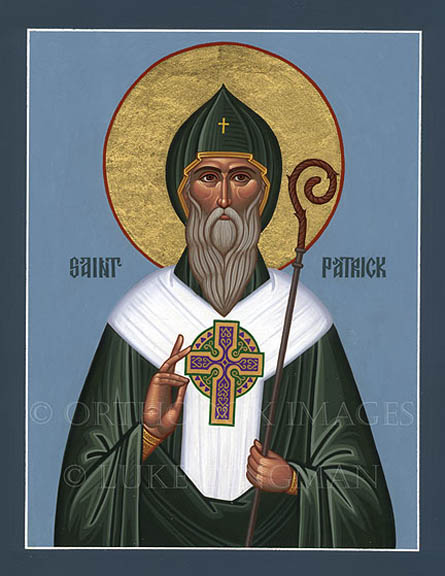


12/20/2007
Mormon Theology

A conversation today about Mormon Theology (stovepipe hats with golden tablets and magic stones inside), led me to look over the wiki page about mormonism. Several surfs later, I'd discovered some fascinating things, including that the mormon stance on Adam (the progenitor of the human race) is that he was the physical incarnation of the Archangel Michael, who was also one of three beings involved in the creation of the world (Yahweh, Elohim, and Michael). Additionally, Noah (of ark fame) was actually the physical incarnation of the angel Gabriel. Fascinating stuff.
It sounds pathetic, but the internet (and specifically, Wikipedia) has just made my life immeasurably better. I'd never have come up with this info before the internet. But now I know... and knowing is half the battle! (Thanks, Joe!)
Subscribe to:
Posts (Atom)
..................................