Showing posts with label science. Show all posts

11/15/2010

Rock Hound

Our 4 year-old boy has been a fiend for rocks since he's been old enough to pick them up. A visit to the lakeshore invariably ends with his gallon ziploc filled with non-descript nuggets. On vacation in Vermont, we visited a granite quarry: he completely ignored the multi-ton slabs being lifted on cables from thousands of feet below, and spent his time examining the exotic (to him) crushed granite parking lot. In fact parking lot gravel and landscaping pebbles have always been his focus. They're just the right size for putting into pockets.

Pockets full of rocks make their way home from daycare with defeating regularity. Though this tailed off briefly with the beginning of K4, it soon ramped up again with his discovery of a magical word. "FOSSIL". He didn't really know what it meant, despite my best efforts, but every piece of gravel brought home had to be examined for "fossils". Every void, every nodule in a piece of gravel was evidence that this piece, too, was one of the magical items.

When I picked the boy up today, heinformed me that he'd found a fossil today. I envisioned another hour spent staring at fists full of gravel. But today, I got a surprise! Today, the boy actually found a fossil in the gravel! It's a horn-shaped rock about an inch long with some grooves along the sides. A little web-searching identified it as a fossilized horn coral. That a web pic of horn coral fossils at right. TheBoy's looks a lot like the one in the top left corner. How cool is that?

The best part is that I'd never heard of horn coral before, so I got to learn something new today, too! According to wiki, these little guys lived in the seas that blanketed this area 250 to 350 million years ago. They would have been attached to a solid surface at the small end with, possibly, a ring of poisoned tentacles surrounding the wide end. Poisoned tentacles score double points for K4 kids (and middle aged geeks, too), FYI. Now that I know what they are, I'm sure I'll be seeing them everywhere... and all thanks to my little rock hound!

4/21/2009

Physics Question

Ok, so given that an electron and an anti-electron* will annihilate each other, resulting in a burst of energy, and that a proton and an anti-proton will annihilate each other, resulting in a (presumably bigger) burst of energy.... what happens if an anti-electron encounters a proton? There's something like an 1840x difference in masses, so they can't just annihilate each other, right? And if the anti-electron only combines with 1/1840th of a proton, what happens to the rest? We've got to be talking partially destroying a quark, right? Any partical physicists wanna help me understand what happens?


* OK, fine, positron. Damn geeks.

4/09/2009

All day long

Some friends will be visiting from North Carolina this weekend, passing through on the way to Minneapolis for Easter. This got me thinking about our recent driving vacations and one of the things I hate about driving south in the summer- the days get shorter!. Most of us realize that far northern areas have times when the sun doesn't set, but sometimes we don't make the logical step that in the summer (for instance at the summer solstice), the further south you go, the shorter the daylight becomes. I found a lovely chart at this website:

The chart is easier to read at the actual site. Sorry about that. You can visit the US Naval Observatory, too. They have a gizmo that will calc sunrise/sunset for you. The point, though is that at Summer Solstice, the day in Minneapolis (~44 deg N) is about 15 hours and 37 minutes, while in Charlotte, NC (35 deg N) the day is only 14 hours and 32 minutes long. More than an hour of additional daylight for the Twin Cities! Yes, that'll show those southern good-for-nothings! (Please ignore the fact that the longer your summer solstice day, the shorter your winter solstice day)

Here's some more cities, with day length at Summer solstice, in case you're interested:

Milwaukee 15:23, Houston 14:04, Key West 13:40, Anchorage 19:22, Seattle 16:00, Honolulu 13:26.

Oh, and to satisfy the sticklers, yes, actual daylight is longer than the difference between sunrise and sunset, as it includes twilight (which also increases and decreases in length along with the "day proper") and that calculated sunset and actual sunset can differ due to bending of light rays by the atmosphere, yada, yada, yada.

4/03/2009

Finally, another wonders...

Wondermark had a great cartoon today. It's about cavemen and crying babies. I've reproduced it here (click to read):


Since my daughter (TheGirl) was born, I have wondered a similar thing. More particularly, I've wondered how it is that mankind has survived this long when newborns are so very fragile and so very irritating. (Oh give me a break. Kids are great, but babies? They're fucking pains in the ass...) As infants, each of my kids has pushed me to within a hair of insanity. Certainly, caveman babies behaved similarly. And presumably, cavemen were even less restrained than I am. So why weren't all the babies killed back then?

All I can think of is that the real torture of screaming infants is staying there and dealing with them. Society insists that we not abandon our kids, even for a little while (say, long enough to get a good night's sleep). Maybe the cavemen just took off when they got crazy... headed out to the nearest proto-tavern, and ate fermented berries until the sun came up.
NO? OK, an alternte theroy... maybe babies were being dropped over cliffs, and that's the reason for the extreme population bottleneck that DNA analyses see signs of about 70,000 years ago. In this theory, we'd have to have been about to exterminate our species via infanticide when whatever is is that kept me from chucking the kids out into the wintry night developed for the first time in cavemen... and mankind blossomed.


[Ed. note - by "cavemen" I am referring to early humans, either anatomically modern, or nearly so. Yes, I know that the term technicaly refers to Neanderthals, and I know that there's no evidence surviving humans are related to Neanderthals. So give me a break, 'K?]

11/12/2008

Google Flu Trends

This is pretty cool. It turns out that by aggregating daily search numbers for certain influenze-related terms, google can track regional flu activity about as well as the CDC (see chart below). It's all part of googles Predict and Prevent initiative. The coolest part, is that googles data is available essentially in real time, while the CDC data takes two weeks to gather and compile.

So, watch google flu trends to see when the flu hits your area. You'll be reading about it from the CDC about two weeks later.

9/23/2008

Finally! A real sunspot

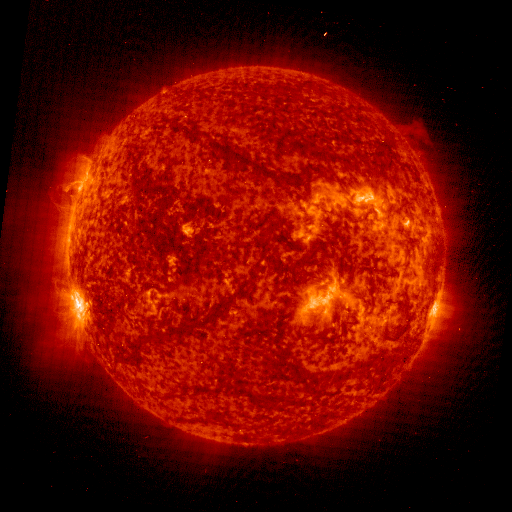
They've finally seen a real sunspot again this week! SOLARCYCLE 24.com has pics, including the one at right. That bright patch in the upper right quarter is the sunspot. Other filters show it as a dark spot. Last time we saw a real sunspot (not some anomally that can't be seen in the visual wavelengths, but that is being counted anyway) was June 23rd. Call it 92 days.

Of course the official number is much smaller, because of the Nothings they called a sunspot in July and early September. Either way, though, we don't beat the 95 day sunspot free stretch of 1913.

The interesting thing to be seen is what happens to the climate if this continues. The maunder minimum was a 70 year period with very few sunspots visible that just happened to be coincide with the Little Ice Age. Will we have another little ice age? Make a guess - in my opinion, it's unlikely that you'll do better or worse than most climatologists. I wonder if Al Gore has a slide show ready for the perils of glacial advance?

8/14/2008

Flaring Grapes

This is pretty cool. Slice a grape in half, but leave the last bit of skin intact, holding the halves together. Then, microwave it. When I tried it, I immediately got small flares (plasma?). The link in the title has pics of little plasma balls. How cool is this? And how many microwaves will be filled with cut grapes and nuked into oblivion? And (most importantly), why does this happen? Thoughts anyone?

YouTube is full of videos of this. Here's one (not mine):

4/30/2008

Appliance Sanity

By now, we've all heard that your appliances use electricity, even when they're not in use. This made sense to me for some things (computers, telephones, stereos), but not for others (the oft cited toaster). So, I dug around a bit, and finally found a guy who'd done the leg work of checking current draw on his appliances. His post is here. I've included his table of energy use below. Just click it to expand it to a readable size.

The long and the short of it? If you're concerned about saving electricity, turn off your appliances when you're not using them, and unplug your computer and your entertainment system if it makes sense (with our cable box, boot up takes about 10 minutes, so unplugging is not an option). But if you think the savings will pay for your next vacation, I hope you're only planning a trip to the local Snappy Snack Shack.

2/14/2008

Don't let your kids see this!

No, it isn't a biopic on Brittney Spears. Nor is it a treatise on the extraction of psychoactive compounds from banana peels. It's better. This website is loaded with videos of wonderful things to do that will destroy your belongings.For instance: melting a beer bottle! I fear that if you do this with your microwave, it will no longer be fit for heating your HotPockets. But its excellent. In other news: Hey, can I borrow your microwave?

12/22/2007

Chemist Santa


It's probably too late now, but wouldn't these be excellent christmas cards for scientists? They're from defetko's etsy shop. Why don't I look for this stuff at etsy in the first place?!?

11/15/2007

Casting Ant Nests

I just saw this guy (Walter R. Tschinkel, of Florida State University) on the History channel, and the stuff he's doing is way cool. He makes castings of ant nests. Pours dental plaster or molten metal down ant holes, let's it set up and then carefully digs it out. The resultant structures are mind-blowing. Very cool. And it's for science. Without this sort of casting, I imagine we'd have no idea at all about the structure of ant nests! According to the paper, mature nests of the species he studies can be 3 meters deep (which I guess is about the size of the one at left).
Click the title for a link to his paper, which contains a load of pics at the bottom. Say... wouldn't it be cool to make these for sale? I wonder how much you'd have to charge to get a reasonable turn on your time?

11/10/2007

I Feel Fantastic!

Thanks to 95th anniversary celebrations at the church that TWaK attend, I’m home alone tonight. With no one to interupt or complain, I decided to take some time to sift through AmieStreet, looking for rare gems. Well let me tell you, gentlereader, I’ve found them, as written and performed by Jonathon Coulton.

Sportsracers may remember Mr. Coulton from his lovely adaptations of zefranks songs from theshow. Other internet junkies may know him from his Thing a Week series of tunes. However you knew of him in the past, it turns out that you should know him from Popular Science.

It seems that in 2005, PopSci hired him to produce an album of songs addressing The Future of the Body. The album is entitled “Our Bodies, Ourselves, Our Cybernetic Arms”, and it kicks ass. My favorite of the five songs on this mini album is “I Feel Fanatastic” (linked in the title of this post), which looks at the inevitable result of skilled pharmaceutical manipulation of our moods and reactions. ("driving on drugs feels better when they're prescription")Best of all, the songs can be downloaded for free from Popular Science! Or if that disappears, buy them on amiestreet, like I did. (40 cents apiece or less than $2 for the whole album, at the time of writing).


10/17/2007

Galazy Zoo


The Sloan Digital Sky Survey (SDSS) is recording images of a large portion of the sky that will eventually encompass a million galaxies. With such a large number of galaxies, astronomers can finally begin to understand how they form and evolve by comparing various populations to each other with large enough numbers to draw real conclusions about their origin.


The problem? Each of these galaxies needs to be identified as either a sprial or an eliptical galaxy, in order to derive the relationships which the survey seeks. And there are some jobs that computers just aren't up to yet. Or at least, getting a computer to perform them requires ridiculous amounts of processing power. Among these is the determination of whether a galaxy is spiral or not, and whether a spiral galaxy appears to be rotating clockwise or counter-clockwise.

So, they're asking for our help. Sign up at Galaxy Zoo, run through the training images, take a short (15 question) test to prove that you've been paying attention, and start digging into the images. Some of them are amazing. I snagged the pic for this post from one that I was asked to categorize. I'm sure the best are still ahead. And don't worry that you'll make a mistake and screw up the project. Each of these images is reviewed multiple times in order to determine its type. If you screw up, others should catch the mistake. Give it a look!

6/26/2007

A moment of science

As we all likely know by now, Mr. Wizard recently passed away. In order to honor his memory, rebecca from skepchick has proposed the we all engage in a 'moment of science'. Watch the video below (thanks to astropixie, another member of SUGAA for pointing out the video), then make a short science video and post it to youtube as a response. Surely someone out there has some raw footage of interesting projects they've worked on that could be gussied up into a science demo with a bit of voiceover work (say... the effects of gravity on pumpkins, or somesuch). I'm drawing a blank on what to do, but mayhaps I'll come up with something in the next few days and film it over the weekend. I urge you all to do the same!

6/21/2007

ISS Flyover

Thanks to an alert from... hmmm... let's call her... Mighty Ow, I was able to catch the International Space Station zipping by overhead last night, followed at a respectable distance by the Space Shuttle Atlantis. The hazy layer of clouds might have obscured lesser satelites (and did, in fact, obscure the expected Iridium flare from my seeking eyes after several additional minutes of cloud arrival), but the ISS and HST managed to shine through the haze.

I've watched satelites pass by before. One fine summer evening, I sat out on our deck with DORADO and picked out dozens passing by before the cricks in our necks and the strange feeling of being watched sent us back indoors. On a clear night, it is only necessary to remove unneccessary light sources and gaze quietly upward for a while to find the tiny dots of light whizzing by. (if partaking of certain alkaloidal chemicals, I understand that it is not even necessary to gaze upward). But the ISS/HST combo put these puny pricks of light to shame.

For these lights were not only wonderfully bright. Their paths through the sky were also unusual, for these two pinpricks of light following the same trajectory through the night skies. Separated by only an armslength handsbreadth of starfield (say that three times fast), they soared along. As I understand the situation, the shuttle had separated from the ISS only a few hours earlier, and was still building up the separation.

Seeing a satelite whiz by always gives me a little burst of pride in Mankind. To think that we (or rather, We) have sent these small packages to their ridiculous heights, where they travel at their ridiculous speeds, solely to help people in SanFrancisco order prank Tandoori deliveries for their friends in London... well that's pretty damn cool.

But to see two spots of light whizzing by, slowly separating like friends in the parking lot after the show, and to know that there are actual people on each of them working hard to figure out what to do with this whole "space" thing and , more immediately, how to deal effectively with the ridiculous heights and speeds without getting smashed against our little planet... well that's pretty much blows my freaking mind!

PS: If you're interested in seeing the space station, or Iridium flares, or other interesting manmade satelites, check out heavens-above. They can show you just what's coming and when, and they'll give you nifty little sky maps to help you find it.

6/13/2007

Evaporation


Check out this cool t-shirt at Etsy! The graphic is an illustration of evaporation from an old Japanese text book. Alternatively, it could be taken as a representation of The Rapture. Something for everyone, I guess. You choose. A bargain at only $15 plus shipping! (This isn't mine, and I don't know the folks selling it. I just think it's really cool).

12/22/2006

Durable Snowflakes


Popular Science has a great bit on how to "Save a Snowflake for Decades". It sounds pretty simple. Pre-chill microscope slides, cover slips and regular super glue. Catch a snowflake on the slide, add a drop of superglue, drop on the cover slip, and store in the freezer for a couple of weeks while the glue sets. voila! I've got to try this next time we get a good dendrite snow. The pic at right is from the popscience page.

1/05/2006

Eureka!

Back when I was in college, 15-plus years ago, one of my professors was talking to me about the lines one sees when the process of dissolving a substance produces streaks of varying concentrations and, therefore, varying refractive indices. The term he used was also applied to the shimmering lines seen rising from a candle, or from the pavement on a hot summer's day.


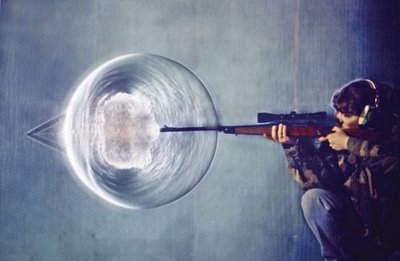
The term I recall him using was 'skirlian' lines, but a couple of years later, out of school and in the work force, I was unable to locate a definition for the term. Over the years, I've searched now and then for the term - in dictionaries, on the web, wherever I could. Today, while perusing American Scientist at the grocery store (American Scientist in a grocery store magazine section! Have I mentioned I love Woodman's in Kenosha?), I saw the term again, spelled properly as 'Schlieren'. I imagine my prof had pronounced it incorrectly as 'sklee-ren', and my brain muddled it up with the word 'Kirlian' (as in Kirlian photography) over the years. Now, American Scientist was using the term to describe the effect as a means of visualizing shock waves, as when a rifle discharges.


A quick look around the web found a few definitions that were close, but finally, American Heritage Dictionary gave me a definition that seemed to fit:

2. Regions of a transparent medium, as of a flowing gas, that are visible because their densities are different from that of the bulk of the medium.

Google searches on Schlieren + concentration produced loads of hits describing the phenomenon I was familiar with. A decade and a half of searching is finally at an end. At last, the time for rest has come.

PS: This guy has some really cool Schlieren photographs. Check them out!

..................................

..................................